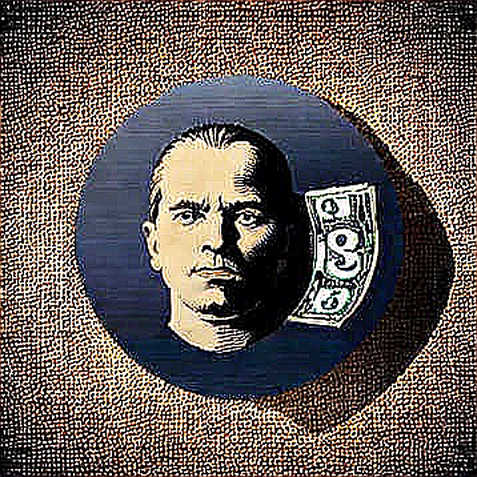
Fifty-two million dollars, aimed at a single Senate seat in a state most crypto traders have never set foot in.
That is the number now attached to the escalating campaign against Sherrod Brown, the Ohio Democrat who has chaired the Senate Banking Committee and who has, for years, been one of the most dependable votes against anything resembling a workable digital-asset framework. At least two industry-aligned political action committees are pooling money to end his career. Not to pass a bill. Not to kill a specific rule. To change who holds the gavel.
Read that again, because it is the entire story compressed into one sentence. In a bear market where alt liquidity is thinning and DeFi protocols are quietly bleeding depositors, the most consequential capital allocation in crypto this cycle is not going into a token. It is going into a Senate race in the Midwest.
And almost nobody is pricing it.
The context matters more than the headline. Brown is not a generic incumbent. He sits at the top of the committee that oversees the SEC and the CFTC, the two agencies that have spent the last several years deciding — through enforcement rather than legislation — what crypto is legally allowed to be. The Banking Committee is where a market-structure bill lives or dies. It is where stablecoin legislation gets marked up, watered down, or buried. Committee chairmanship is not a symbolic post; it is the choke point through which every piece of digital-asset law must pass.
That is why the target selection is so precise. The industry is not spraying money across forty races. It is concentrating fire on the one seat where a flip would rewire the oversight apparatus itself. Ohio is expensive, swingy, and nationally watched — the perfect place to test whether political capital converts into legislative leverage.
The structure of the spending is equally telling. Individual firms lobbying alone are easy to isolate and easy to punish. Political action committees solve that by aggregating industry money into a single, deniable instrument. It is the invisible contract binding our digital tribes — a coordination mechanism that lets competitors fund a shared objective without ever signing the same document. When at least two PACs converge on the same target, you are not watching coincidence. You are watching a strategy with a spreadsheet behind it.
Here is the transmission chain, and it is longer than traders want it to be. Senate seat changes hands → committee gavel changes hands → oversight posture toward the SEC and CFTC shifts → market-structure and stablecoin bills move or stall → compliance certainty rises or falls → valuation multiples on regulated crypto businesses expand or compress. Five links. Any one of them can break. The market, conditioned on twelve-second candles, prices this as if it were a single event.
Based on my audit work through the 2025 Toronto institutional onboarding sessions — where I sat with hedge fund compliance officers drafting transparency standards that three firms eventually adopted — I can tell you exactly which link in that chain the money is actually buying. It is not the bill. It is the certainty. Institutions do not need friendly law; they need predictable law. A fund that cannot model its regulatory exposure three years out will not allocate, regardless of how bullish the chart looks.
Which brings us to who is really paying, and why. The largest chequebooks in these PACs almost certainly belong to the entities with the most direct exposure to US enforcement: exchanges and stablecoin issuers. This is not altruism. Binance's $4.3 billion settlement did not weaken the largest venues — it entrenched them. A penalty that size is a moat, because it converts compliance infrastructure into a fixed cost that only a handful of firms can carry. Every new licensing regime raises the entry ticket. The incumbents are not funding these PACs to liberate the industry. They are funding them to make sure the next licensing round is written by people who already know their names.
Catching the signal before the market blinks means recognizing that this spending is a cost line, not a revenue line. Fifty-two million dollars does not accrue to any token holder. It does not show up in a protocol treasury report. It is a levy on the industry's accumulated surplus, redirected into political capital, and its return is measured in policy friendliness rather than APR. That distinction matters enormously in a bear market, because it means the cash is leaving the system.
There is a partial transparency angle here that most coverage misses. Corporate treasuries are increasingly on-chain — stablecoin balances, exchange wallets, foundation addresses. While PAC filings with the FEC lag by weeks or months and can route through nonprofit intermediaries, the upstream corporate movements are far more legible than they were in 2017. When I audited the 21.co tokenomics in 48 hours and found the vesting misalignment before anyone else published, the lesson was not that on-chain data is magic. It was that disclosure gaps are where risk hides. The same discipline applies here: watch the treasuries, not the press releases.
Now the contrarian angle, and it is uncomfortable.
The first problem is arithmetic. Flipping a Senate seat does not flip a committee gavel automatically. Seniority, caucus rules, and the filibuster all sit between an election night and a legislative outcome. Markets that price a Brown loss as an immediate regulatory unlock are pricing a chain reaction that historically takes quarters, not days. Policy turns slowly. It always has.
The second problem is narrative blowback. An industry that built its public identity on decentralization is now deploying the most centralized financial instrument in American politics — aggregated committee money — to remove a regulator it dislikes. That is legal. It is also, optically, a gift to every critic who has argued that crypto is simply finance with better marketing. If the spending is framed as an attempt to purchase a committee, the backlash does not arrive from one party. It arrives from both, and it arrives as targeted, punitive legislation rather than vague hostility.
The third problem is that the money does not discriminate. A PAC that succeeds in Ohio will be replicated in a dozen other districts. What looks like a targeted strike is really the opening move in an arms race, and arms races have a way of consuming the surplus that funded them.
So what do you watch, if you are not going to trade a headline?
Watch the FEC filings against prior cycles, because the aggregate number tells you how anxious the industry actually is. Watch the committee gavel, not the vote count. Watch whether a market-structure bill reaches markup — that single procedural step matters more than any election-night reaction candle. And watch the stablecoin issuers specifically, because they are the ones whose entire business model depends on the answer.
Leading the herd through the volatility fog has never meant predicting the weather. It means knowing which direction the ground is sloping. In a bear market, the protocols that survive are the ones with a legal path forward, and the $52 million in Ohio is the industry buying that path — expensively, clumsily, and with no guarantee of delivery.
The real question is not whether crypto can afford to spend this. It is whether the industry that spent it will still recognize itself once the bill arrives.