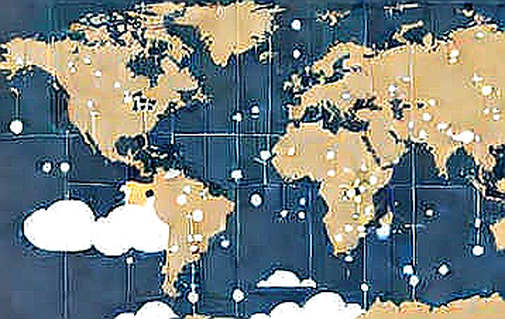
The Handshake and the Ledger: What the UAE-Iran Meeting Reveals About the Rails We Are Actually Building
If you spent the week of the BRICS summit watching on-chain settlement flows rather than headlines, you would have caught what the market missed: a quiet, sustained thickening of activity across corridors linking the Gulf to the Iranian littoral — flows too small to trip a single dashboard alarm, too persistent to dismiss as noise. The wires gave a sparer signal. UAE and Iranian leaders had met for the first time since the war began, on the sidelines of the summit. Most crypto desks republished the item as boilerplate geopolitics and moved on. I did not. A handshake between two states that remain formally at odds is not a beginning. It is an admission — that the infrastructure making the conversation possible already exists, and has existed longer than either side wanted to say aloud. Diplomacy is the visible thumbprint. The ledger underneath is the hand.
I want to be careful, because the reporting is thin. No fixed date, no agreed agenda, no joint statement, no clear definition of the war in question. That absence is itself data. It forces us to reason from structure rather than from text: from the architecture of parallel finance both states have spent years assembling, and from what decentralized verification can and cannot do in a world where trust between governments is not merely scarce but structurally unavailable. Stillness reveals the signal beneath the noise. And this meeting was very still.
Context: The Rails Beneath the Communiqué
We have been trained to read geopolitics through summits, communiqués, and the choreography of state visits. That reading is incomplete. Underneath every diplomatic thaw lies a settlement layer — a set of mechanisms for moving value across a border without waking the machinery of dollar clearing. For half a century that layer was SWIFT and the correspondent banking chain, both ultimately anchored in New York. Since roughly 2019, a second layer has been forming in the seams between them: stablecoins, bilateral swap lines, regional instant-payment bridges, and the early scaffolding of what BRICS member states now describe, carefully, as local-currency settlement.
None of this is glamorous, and almost none of it is public-facing. It is the kind of infrastructure that does not announce itself, because announcing it would defeat its purpose. The point of a parallel rail is not to be seen replacing the old one; it is to be available at the exact moment the old one becomes unusable. For Iran, that moment arrived in 2012 and never fully ended. For the UAE, that moment has not arrived — and the entire strategy of Abu Dhabi is to ensure it never does.
To understand why two estranged states would meet on the sidelines of a summit, you have to understand what each is actually buying. Iran is buying legitimacy and an exit from isolation. The UAE is buying optionality — the ability to keep its American security umbilical cord while building independent commercial arteries to everyone else, Iran included. Both are buying something more subtle: verification. In a region where every party claims to be acting in good faith and none can prove it, the scarce commodity is not trust. It is evidence. Trust is not given; it is verified.
This is where the story stops being purely diplomatic and becomes, quietly, a story about protocol design. Because the parallel rails now being laid are not neutral pipes. They are choices about who can transact, who can be frozen out, and who holds the keys. And the answers to those questions are being written in code this year, by people who will never attend a summit and whose names will never appear in a communiqué. The geopolitics is the headline. The protocol is the article.
Core Analysis: The Architecture of Escape
Let me start with the mechanism, because the mechanism is the politics.
When a state is sanctioned, its problem is not that it lacks value. Its problem is that it cannot move value through the channels everyone else uses. The dollar-clearing system is not a customs house — it is a permissioning layer, and permission can be revoked. Iran learned this the hard way. Any bank that touches a sanctioned entity risks losing access to the dollar system entirely, so the rational move is to refuse the transaction before it happens. This is not a wall at the border; it is a wall inside every counterparty's compliance department. It is the most effective form of financial coercion ever built, precisely because it does not require coercion at all — only coordination.

Parallel rails exist to route around that coordination. Three forms are now materially live, and each tells us something different about the ethics embedded in the code.
The first is the crypto-native rail: stablecoins, principally dollar-denominated, settled on public chains. Iran has a documented history here. TRON-based USDT has been for years the workhorse of sanctioned-entity settlement, because it is liquid, widely accepted, and — crucially — not controlled by a bank that can be leaned on. The mechanism has a known fracture line: the issuer can freeze addresses unilaterally, and has. This is the central paradox of permissionless money that is issued by a permissioned entity. Code is the only permission we truly need — except when the code has an upgrade key held by a compliance team in a midtown office. The rail is decentralized at the edge and centralized at the root, and the root is where the leverage lives.
The second rail is the state-bilateral one: central-bank swap lines and local-currency settlement agreements, increasingly routed through platforms like the BIS-linked mBridge experiment, whose membership overlaps uncomfortably with the countries now meeting on BRICS sidelines. This rail is slower, more bureaucratic, and vastly more resilient to address-level freezing. Its weakness is liquidity: a bilateral corridor is only as deep as the two parties choose to make it, and depth requires mutual trust in the settlement asset. When that asset is a local currency nobody else wants, the corridor stalls. Which is why so many of these corridors ultimately want a stable settlement asset — and the only one with global depth is the dollar they are trying to escape.
The third rail is the gray one: free-trade zones, re-export networks, currency exchanges, and hawala channels, many of them physically anchored in the UAE. This rail is old, human, and extraordinarily hard to map. It is also where crypto increasingly intersects the physical economy — not as a replacement for the gray market, but as its accounting layer. When a shipment's value needs to cross a border without a paper trail, a stablecoin transfer is frequently the quietest way to settle the difference. The rail is not blockchain replacing finance. It is blockchain becoming the invisible ledger of finance that would prefer not to be documented. That is the insight almost nobody articulates: for the gray economy, the blockchain's value is not freedom. It is finality without paperwork.
The UAE's Double Position
Here is the difficulty with reading the UAE. Abu Dhabi is simultaneously one of the most aggressively regulated crypto jurisdictions on earth and one of the historically most porous conduits for value that the dollar system would rather not see. Both facts are true at once, and neither cancels the other. The UAE built VARA and ADGM to attract institutional capital — which means it has spent years telling the world, credibly, that its rails are clean. It also inherited a trade geography in which Dubai's re-export economy and currency-exchange networks have long been scrutinized for precisely the kind of flows its regulation now claims to prevent.
The meeting on the BRICS sidelines does not resolve this contradiction. It exercises it. A state that wishes to be both a trusted node in the American security system and an independent commercial actor in the Eurasian one does not choose. It runs both rails, keeps the overlap ambiguous, and lets deniability do the work. This is multi-vector hedging at the level of a nation, and it is not cynicism — it is the rational behavior of a small, wealthy, militarily exposed state surrounded by larger, more dangerous neighbors. The UAE cannot afford an enemy with a coastline sixty kilometers from its own. So it buys insurance: American hardware for deterrence, Iranian dialogue for proximity, and Chinese platform membership for optionality.
I have watched this pattern at the protocol level for years. In 2017, at the height of the ICO mania, I turned down a lucrative centralized-exchange token sale to spend three weeks auditing the relayer architecture of 0x. Everyone around me thought I had lost my mind — I was choosing schematic diagrams over a check. But what I learned in those three weeks shaped how I read every market since: the durable value in a system is almost never in the thing being sold. It is in the rails that let the thing move without permission. The UAE is not buying an Iranian friendship. It is buying a rail. And rails, unlike friendships, can be audited.
What Decentralization Actually Offers — and What It Doesn't
Now the part I care about most, and the part I suspect most crypto readers will get wrong.
There is a popular story that sanctions and parallel rails are the great use-case for crypto — that when a state is shut out of the dollar system, decentralized networks will simply route around it, permissionlessly and forever. This story is half-true, and the half that is false is the half that matters. The truth is that decentralized networks do not eliminate the need for trust. They relocate it. They move it from the intermediary to the code, from the bank officer to the upgrade key, from the compliance department to the oracle. And where the oracle is a cartel of stablecoin issuers who can freeze a trillion-dollar float on a Tuesday, the relocated trust is not obviously better than the trust it replaced.
I wrote a manifesto about exactly this in 2020, after two friends and I spent two hundred hours simulating Compound's mechanics to test whether undercollateralized lending could reach the underbanked of Southeast Asia. The conclusion broke something in me: the protocol was elegant, and the elegance was the problem. Over-collateralization reproduced exclusion in a new vocabulary — you could not borrow unless you were already rich enough not to need to. The system was efficient. It was also a mirror of the order it claimed to replace. That lesson — that architecture carries ethics whether or not its designers intend them — is the lens I bring to every parallel rail now being built.
Apply it to the BRICS corridors. The rhetorical claim is decentralization: no single gatekeeper, no veto, local-currency sovereignty. The reality, at this stage, is a set of bilateral arrangements between central banks — which is to say, a set of central gatekeepers, merely arranged in a different constellation. De-dollarization as commonly narrated is not decentralization. It is re-centralization under a different flag. And if the settlement asset of the future is a state-issued stablecoin governed by whichever central bank has the most leverage, then the point of the original exercise has been quietly abandoned. The escape from one gatekeeper can become a flight into twenty.
This is why I am skeptical of the RWA narrative that has dominated the last three years of conference stages. The story goes that tokenizing real-world assets will let institutions settle cross-border in a frictionless new layer. But the institutions don't need our public chains; they have their own permissioned ledgers, their own consortiums, their own compliance officers, and — crucially — they can already settle with each other using the dollar system they built. What they want from crypto is not freedom. It is efficiency, wrapped in a story about freedom so it can be sold upstairs. Tokenized treasury products are not a portend of a decentralized future; they are the dollar system learning to run its own blockchain and calling it innovation. When I advised a major UK pension fund in 2024 after the spot Bitcoin ETF approval, the debate in the room was never about ideology. It was about whether the asset could be reconciled with fiduciary duty. The institutions will adopt the rails that make them faster and keep them in control — not the rails that make them irrelevant.
The Fragmentation Disease
And when multiple parallel rails proliferate — mBridge, bilateral swaps, stablecoin corridors, regional instant-payment bridges — we should recognize the pattern, because we have watched it before.
Dozens of Layer2s now exist, and the same small pool of users is being sliced among them. That is not scaling; it is the fragmentation of already-scarce liquidity into ever-thinner shards. Each new rollup promises unified settlement and delivers a silo; each new bridge promises composability and delivers another attack surface. The rollup thesis assumed that fragmentation would be temporary and that finality would re-aggregate at the base layer. What actually happened is that finality fragmented too, and the base layer became one settlement zone among many.
Parallel sovereign settlement rails risk the same disease at the level of countries: a dozen corridors, each too shallow to be reliable, collectively less efficient than the single rail they meant to escape. A bilateral corridor between two sanctioned-adjacent states is a Layer2 with no sequencer revenue and no users. It exists to prove a point, not to move value at scale. And economic incentives do not care about the point. They care about depth. Code may be the only permission we truly need, but liquidity is the only permission that works.
This matters for the sideways market we are currently living through. In a chopping market, the temptation is to price every protocol by the narrative attached to it rather than by the depth of the liquidity it actually commands. I have spent twenty-four years watching this error repeat. The protocols that survive the chop are not the ones with the loudest campaigns. They are the ones quietly accumulating verifiable users and honest volume. Patience is the validator of true intent. The market will eventually confirm which rails have real depth and which are merely diagrams.
Verification as the Real Prize
If the parallel rails are interesting, the truly interesting thing is what they need in order to function at all: verification.
Here is the problem neither a handshake nor a swap line can solve. Two adversarial states — or two thousand adversarial counterparties — need to agree that a transfer happened and that the asset backing it is real, without trusting any single intermediary to be honest. In the dollar system, that agreement is provided by the correspondent bank and, ultimately, by the full faith and credit of the United States. It is trust, institutionally guaranteed. Parallel systems do not enjoy that guarantee. They must manufacture it. And the only technology that manufactures agreement without a trusted intermediary, at scale, is the one we have been building for fifteen years.
Consider what a working parallel settlement corridor actually requires. It needs a settlement asset whose supply is verifiable. It needs a record of transfers that cannot be quietly rewritten by a participant who dislikes the outcome. It needs a way to prove that a given entity is — or is not — sanctioned without publishing the entity's entire transaction history. And it needs all of this to work across jurisdictions that do not trust each other's courts.
Each of those requirements maps onto a primitive we already have. Verifiable supply is proof-of-reserves — for all its flaws, a genuine step beyond audited claims. Tamper-evident history is the base layer itself. Selective disclosure is zero-knowledge proofs, which let a party prove a statement — this counterparty is not on the list — without revealing the underlying data. The elegance of the zk primitive is exactly the property a sanctions environment needs: it can prove compliance without exposing the counterparty. You can be known to be clean without being known at all. That is a moral advance as much as a technical one, because it protects the human at the center of the transaction even as it satisfies the gatekeeper at the edge.
And cross-jurisdictional finality is the hardest and least solved: it is not a cryptography problem but a legal one, and cryptography cannot sign a treaty. This is where the BRICS handshake and the zero-knowledge proof share a common ancestor. Both are attempts to manufacture agreement between parties who have no reason to trust one another. One does it with words; the other does it with math. The math is more honest, because it cannot lie about whether it succeeded.
This is why I have spent the last year on the intersection of AI and verification rather than on price. In 2026, leading a team to build a Provenance Layer for human-created content, I learned that verification is not primarily a technical achievement. It is a social one. The cryptography was the easy part; the hard part was convincing ten major media houses that proving provenance was worth a penny per check. Verification fails not because the zeros and ones don't add up but because nobody wants to pay for the addition. The parallel rail problem is identical. The math works. The will is the bottleneck. And the will is where every evangelist eventually discovers that the real work was never about the code at all.
Which brings me back to the handshake. What makes the UAE-Iran meeting meaningful is not the statements, because there were essentially none. It is that it demonstrates a shared willingness to invest in a channel whose value depends entirely on verification — on both sides being able to check, independently, that the other kept its word. The protocol remembers what the market forgets. In the noise of war and sanctions and summits, the quiet, repeated, verifiable transaction is the only thing that compounds. Everything else is a press release.
The War That Wasn't Defined
A note on method, because I care about intellectual honesty more than narrative neatness.
The reporting on this meeting does not define the war it refers to. That is not a small omission. Depending on whether it means the Gaza war, the Iran-Israel direct exchanges, or a broader regional conflagration, the strategic meaning of the meeting shifts materially. The single most important thing to understand about this item is how much of it is unknown. I have learned, from six weeks in a Scottish cabin after the Terra collapse, to be suspicious of my own need for a clean story. The industry's worst betrayals were always dressed as complete narratives. The bear market taught me that. And it taught me something else: that being an evangelist does not mean being certain. It means being honest about what you cannot verify.
So let me mark the boundaries. I do not know what was discussed. I do not know whether either side conceded anything. I do not know whether the meeting will be repeated. What I do know is structural, and I will stake my analysis on structure rather than on supposition: two states with adversarial positioning found it in their interest to be seen talking, and the rails that make such conversations about value — as opposed to just about words — are being laid in code that neither state fully controls and both intend to use. That is enough to act on. It is not enough to be certain about. And the difference between acting and being certain is the difference between an analyst and a fool.
The Contrarian Turn: Crypto Is Not the Escape Hatch
Now the counter-intuitive turn, because the tidy version of this story is almost certainly wrong.
The reflex reading is that crypto is winning — that sanctions are being circumvented, that the dollar is being dethroned, that the parallel rails are the future and the old order is crumbling. I think that reading is a comforting story the West tells itself so it can sell volatility to retail. The reality is closer to the opposite.
The UAE and Iran do not need crypto to escape the dollar system, and they are not really trying to. They need crypto to price the risk of a system they still rely on. Iran sells oil, buys goods, and holds reserves denominated overwhelmingly in dollars and dollar-adjacent assets. The UAE's enormous sovereign wealth is anchored in the American economy; it would not survive a genuine rupture with the dollar system, and Abu Dhabi knows it. What the parallel rails actually provide is not an exit. It is leverage at the margin: a way to say, credibly, that they have somewhere else to go without ever having to go there. Crypto is not the escape hatch. It is the threat that keeps the hatch from being welded shut.
Institutional investors, meanwhile, are fond of telling themselves that blockchain is finally being adopted because the big players have arrived. But the institutions don't need our public chains — they need the appearance of decentralization to justify moving the same old assets onto rails they already control. The tokenized-treasury boom of the last two years is not Bitcoin winning. It is the dollar system wearing Bitcoin's clothes. And the blue-chip label in this world is as fragile as it was for the blue-chip NFTs no one mentions anymore — floor prices that held right up until liquidity left, and then nothing remained. The moment the narrative met the abyss, the label did not save anyone. The same will be true of any tokenized asset whose perceived safety depends on a market that has not yet tested it.
The pragmatism test is simple. Ask not whether a rail is decentralized in theory. Ask whether, on the worst day, when the issuer's compliance team and the state that charters them both want you frozen, you are actually unstoppable. If the answer requires an honest silence, then the rail is not sovereignty. It is convenience with better marketing. And the meeting on the BRICS sidelines, for all its geopolitical weight, does not change that arithmetic by a single zero.
Takeaway: What to Watch in the Quiet
So watch three things, and watch them quietly. First: whether the corridor between the Gulf and Iran deepens or evaporates in the next two quarters — the flows will tell the truth that communiqués will not. Second: whether any of the parallel rails adopt a settlement asset whose supply and transfer history are verifiable by an outsider, because that is the difference between a currency and a confidence trick. Third: whether the UAE's regulatory posture and its trade geography finally converge, or whether the gap between them is institutionalized for good.
We build in silence so the network can speak. The handshake made a headline; the ledger made a permission. Only one of them will still be confirming transactions when the summit is forgotten — and the protocol, as it always does, will remember what the market chose not to.