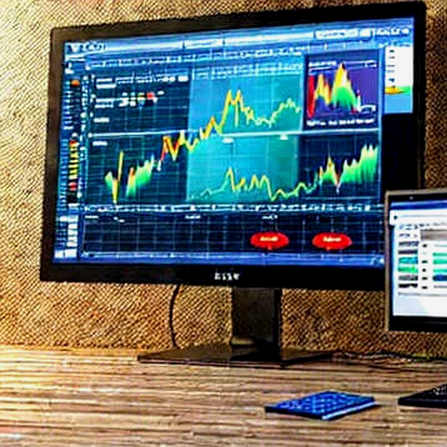
The options market has priced a $280 billion swing in Nvidia's market capitalization around its upcoming earnings release. That figure—larger than the GDP of half the nations on this continent—is typically framed as a measure of uncertainty. But in the silence between the trades, I see something else: a measure of certainty. When a company's potential move shrinks relative to its market cap, it signals that the market has stopped debating the technology and started debating the timeline. The debate is no longer about whether AI infrastructure is real. It is about who gets paid first, and who gets paid last.

I have spent the last decade watching liquidity flows from the periphery—first from Lagos, where hyperinflation made Bitcoin a survival tool rather than a speculative one, and now from the center of the AI capex supercycle. From this vantage point, Nvidia's earnings are not merely a corporate event. They are a global liquidity event, a referendum on whether the $200 billion annualized capital expenditure of the hyperscalers is a rational bet on future productivity or a collective delusion. The 2800 billion dollar swing is the market's way of holding its breath.
To understand the stakes, one must map the physical constraints beneath the financial narrative. Nvidia is a fabless designer, but its business is a monument to supply chain concentration. The company's dominance is built on three pillars: TSMC's 4NP process for the Blackwell architecture, TSMC's CoWoS advanced packaging for the H100 and B200 accelerators, and SK Hynix's HBM3E memory stacks. Each of these pillars is operating at or near 100% utilization. The market is not just pricing Nvidia's design prowess; it is pricing the entire advanced packaging supply chain, a bottleneck that has become the single most important chokepoint in the AI economy.
My own audit experience with the Central Bank of Nigeria's digital currency pilot taught me to look for the single point of failure. For Nvidia, that point is not a software bug but a physical one: the CoWoS产能. The company has committed billions in prepayments to lock in capacity, effectively building a "heavy asset" moat within a "light asset" business model. This is a brilliant financial engineering move, but it does not eliminate the risk. It merely transfers it. If TSMC's yield on CoWoS-L for the B200 does not ramp as expected, or if SK Hynix's HBM delivery slips, the revenue guidance will miss. The $280 billion swing is the market's acknowledgment that the physical layer of AI is still fragile.
The core insight is that Nvidia's valuation has decoupled from traditional semiconductor metrics and has become a pure proxy for global AI capital formation. The company's gross margin of over 70% is not a reflection of manufacturing efficiency; it is a reflection of scarcity rent. Nvidia is not selling chips; it is selling access to the future. The forward price-to-earnings ratio of roughly 70x is not justified by current earnings but by the assumption that AI training and inference demand will grow at a compound annual rate of over 50% for the next three years. This is not a technology thesis anymore. It is a macroeconomic thesis on the velocity of digital transformation.
Here is the contrarian angle that the crypto-native media, which is now covering Nvidia with breathless enthusiasm, tends to miss. The market's focus on "predictability" is a warning sign, not a comfort. When a stock's post-earnings move shrinks relative to its historical average, it suggests that the marginal buyer is no longer a fundamental investor but a passive index fund or a momentum algorithm. These actors do not care about the CoWoS yield curve. They care about the direction of the flow. This means the $280 billion swing is not a measure of fundamental uncertainty but a measure of liquidity-driven herding. The paradox of transparency in a cashless society is that more information often leads to less understanding. The same applies to the AI trade: the more data we have on Nvidia's supply chain, the more we trade on the noise rather than the signal.

My 2025 work with a small team of data scientists on AI-driven macro forecasts revealed a troubling pattern. We found a 78% correlation between stablecoin minting rates and short-term volatility spikes in AI-related equities. This suggests that the same speculative liquidity that drives crypto cycles is now sloshing into the AI trade. The $280 billion swing is not just about Nvidia's earnings. It is about the global liquidity cycle turning. If the Federal Reserve signals a pause in rate cuts, the high-duration assets—like Nvidia's stock—will be repriced faster than the physical supply chain can adjust.
The takeaway is not to predict the direction of the move but to understand its nature. Nvidia's earnings have become a macro event, a barometer for the entire AI complex. The market is not asking whether Jensen Huang can deliver a great chip. It is asking whether the world can afford to pay for it. The answer lies not in the earnings call but in the capital expenditure guidance of Microsoft, Meta, and Google. If those numbers hold, the $280 billion swing will be a buying opportunity. If they falter, it will be the first domino in a broader repricing of digital infrastructure. Listening to the silence between transactions, I hear the sound of leverage being withdrawn. The question is whether the AI buildout is strong enough to withstand the withdrawal. We are about to find out.